









In the realm of film criticism, a significant measure of a film’s value lies in its ability to make an impact on the subjects it portrays. It’s not enough for a film to merely present important issues; it must also do so with care and authenticity. This is especially relevant when representing marginalized communities. Tokenism, a common pitfall, refers to the shallow inclusion of these groups for the sake of diversity, without meaningful representation. Characters often become mere stereotypes or plot devices, stripped of depth or connection to their real-life counterparts.
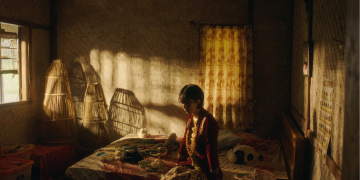
Dina Naser’s short film Sukoun (Amplified) (2024) serves as a profound example of avoiding tokenism by delivering a story that reflects genuine care and insight. The film follows Hind, a ten-year-old deaf karate athlete, as she navigates her passion for karate alongside a traumatic experience of harassment.
While the film could easily be reduced to a label of “important” due to its subject matter, Sukoun stands out for its dedication to presenting the story truthfully and compassionately. Naser’s commitment to accurately representing Hind’s experience, both as a deaf child and a victim of harassment, extends beyond the surface, creating a narrative that is both empathetic and immersive.
First, and probably the most obvious projection of truthfulness is in the immersive way the film invites us to experience the world through Hind’s point of view. Most notably, the sound design captures the way Hind experiences the world to how she connects to the world, and when she chooses to close off the world. Sound designer Ensieh Maleki has successfully carried out writer and director Dina Nasser’s goal of capturing the protagonist’s world accurately and organically.
In this particular process of getting the sound design to emulate Hind’s hearing, as I read in an interview with Dina Naser, they did medical tests with the also deaf actress, Malak Nassar (Hind) to “work out which frequencies she hears and which she doesn’t.” In this sense, Sukoun works to be as true, as accurate, to Hind’s experience.
Naser’s decision to highlight harassment experienced by children in her film, in particular disabled, through her protagonist’s character doesn’t only require technical representations in the form of sound and images, but also a particular compassion and understanding within the writing itself. The immersive images and sound, combined with a story crafted with time, care, and community feedback, offer a compassionate portrayal of injustice from the survivor’s perspective. This approach ensures that the depiction is both truthful and gentle.
Building Trust and Honoring Experiences
In the making of Sukoun, Naser connected with the deaf community. She learned sign language as well as created space for them both in the production and outside of the production of the film. Moreover, with more films being made every day, there is an emphasis on producing films highlighting important social issues. But producing these films in such rapid rates do not give chance for filmmakers to learn and engage with the issues they are representing. With limited time and even production cost, it is easy to easily brush away the work put into research and connection with those we are representing. To me, this the beginning of careless representation. Rather than inclusive, these portrayals of marginalized groups become exploitative, and harmful rather than empathetic.
Sukoun is among the films that is not a victim of this pitfall. Just like the title, Naser’s endeavor to amplify the voices in the deaf community has equipped her with a much-necessary understanding of the community she is representing in film. So much about making a film about marginalized groups is to listen and learn, amplify voices and create safe rooms for discussions. It seems like a no-brainer, but one does not make a film about a community without making seats for them behind the scene.

Moreover, with more films getting made every day, there is an emphasis on producing films highlighting important social issues, as it is what the audience demands. However, producing these films in such rapid rates do not give chance for filmmakers to learn and engage with the issues they are representing. This the beginning to careless representation in film, making them exploitative of marginal groups rather than inclusive, harmful rather than understanding and empathetic.
Other than connecting to a community whose voice she is amplifying, due to the nature of the topic of harassment being delicate, Naser must also approach it with the same compassion and honesty. As she discusses in her interview with Ahmed Shawky, she does this by building a close relationship with her actors, creating a safe space for her young actors to ask questions and feel empowered. Naser cares about the people she is making a film about, and it shows. Where providing inclusive and diverse positions behind the scene is still a rarity in mainstream industry, Sukoun stands as a film that is only made possible by the community it represents.
A Holistic Portrayal of Passion and Strength
Additionally, the film is also pronounced in displaying Hind’s passion and strength, further presenting Hind as more than just a token of representation. Throughout the film, Hind’s passion for karate is the heart that keeps the story going. Hind’s keenness and joy for her passion is apparent, and her mother’s support and understanding of this creates an endearing relationship. More than her disability, Hind is defined by her passion for karate, the love she shares with her mother, and her strength in surviving a harassment from a figure in power in the very place her passion is nurtured.
In dealing with her harassment, it is not her outward response that is highlighted, but rather her inner world. Again, it her Hind’s inner experiences of the outside world that is underlined. This perfectly aligns with how one processes a situation such as harassment: it mostly happens within oneself. The film’s attempt at immersing us in Hind’s eyes and ears is met with a compassionate conclusion of an ending that feels unresolved. It feels fitting; harassment is one thing one could never completely recover from nor solve, its effects lingering with its survivors in unanticipated and unpredictable degrees.
Sukoun shows us Hind’s story with both care and depth, balancing her physical and psychological experiences while highlighting her passion and strength. The film exemplifies the responsible and compassionate representation of minority groups by deeply connecting with and authentically portraying the community it represents.
Returning to the question at the beginning of this article, a film’s true value extends beyond its perceived importance and impact on the subjects it portrays. Sukoun exemplifies this by not only addressing the significant issues of harassment and disability but also by presenting them with genuine empathy and accuracy. The film’s deep, respectful connection with its subjects and its immersive storytelling demonstrates that the impact of a film is truly realized through thoughtful and compassionate representation.











Discussion about this post