

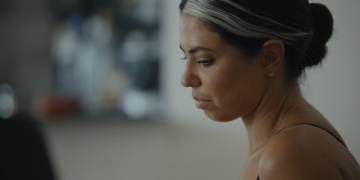







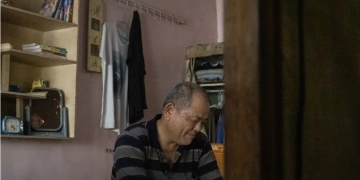



What if the person you love desires something you never knew they wanted? Directed by George Peter Barbari (Lebanon, France, Croatia, 2026), Birthmark explores the uneasy territory between love, sexuality, and secrecy through a wife confronting the sex worker her husband has visited. Birthmark never tells us exactly how to define the husband’s sexuality, and perhaps that’s precisely what makes the encounter so unsettling. For his wife, the question isn’t simply what he did, but why he never told her.
The wife’s attempt to understand her husband only makes the betrayal more vivid. She goes to the sex worker not because she wants them, but because she wants access to an experience she wasn’t part of. She watches and listens, becoming increasingly tense and uncomfortable as they describe what happened. The information she seeks does not give her the clarity or comfort she seems to be looking for; instead, the more she learns, the more difficult the betrayal becomes to process.
The betrayal is less about whom her husband slept with and more about what he chose to keep from her. Her repetition of “He should have told me” makes this especially clear. She feels betrayed by discovering a part of his sexuality that she never knew existed. She wasn’t given the information that might have allowed her to understand or decide what this meant for their marriage. As a woman, what strikes me is that she was never given the opportunity to decide what this knowledge would mean for her. Her husband’s desire may coexist with his love for her, but she still has a legitimate reason to feel betrayed by the secrecy. The encounter also introduces the possibility that love and sexual desire don’t necessarily occupy the same boundaries.
Birthmark isn’t necessarily asking whether a husband can love his wife while desiring something else. Instead, it asks what happens to intimacy when we discover that someone we love has a part of themselves we didn’t know existed. The film doesn’t ask us to decide whether her husband is gay, bisexual, or anything else. By leaving his sexuality undefined, it allows the question of betrayal to remain more complicated: is the betrayal the desire itself, or the fact that it was kept secret? For the wife, the answer appears to be the latter.
By the end of the film, the focus shifts from the husband to the wife and how she sees herself. What has changed is not necessarily her situation; she still doesn’t know what her husband’s sexuality means for their marriage. What has changed is her relationship to herself in that moment. She has spent the entire conversation with the sex worker trying to understand her husband, only to end up looking at herself. They don’t solve her marriage. They don’t tell her what she should do; they simply make her look at herself differently.
I feel the tenderness of the final gesture lies in how it shifts the wife’s attention from what she cannot understand about her husband to how she sees herself. The sex worker doesn’t give her the answers she’s been looking for. Instead, the gesture shifts the wife’s attention from what she cannot understand about her husband to something within herself that she may have been trying to conceal.
A birthmark is something we carry on our bodies, something that is simply part of us, something intrinsic. Like desire, possibly, it isn’t always something we choose or fully understand. Yet a birthmark can also be something we learn to conceal, not because it isn’t part of us, but because we decide that certain parts of ourselves are easier to keep unseen. Perhaps this is where the film’s title becomes more significant. The husband’s undisclosed desire is not necessarily presented as something that makes his love for his wife false; what unsettles her is discovering that there was a part of him she could not see. The film seems to ask whether intimacy requires complete knowledge of another person, or whether there will always be parts of the people we love that remain beyond our understanding.
Perhaps the wife’s journey is not about uncovering the truth about her husband so much as confronting the limits of what she can know about another person. We often imagine intimacy as knowing someone completely, but Birthmark suggests that loving someone does not necessarily give us access to every part of their inner life. The painful discovery is not simply that he has a desire she didn’t know about, but that the person she thought she knew was always more complicated than the version she had imagined.
Birthmark is a reminder that intimacy is not the same as complete knowledge. We can love someone deeply while remaining unaware of parts of their desire, and discovering those hidden parts does not necessarily invalidate the love that existed before.
Editor: Fransiska Prihadi










Discussion about this post