





When Izabela Plucinska talks about her latest film Joko, her face lights up with refreshing candor and obvious passion. “Claymation still fascinates me”, says all smiles the veteran Polish director with close to 20 animation short films under her belt. Her contagious good humor seems at odds with the more sombre tone of her films, which often flirt with the taboo, from domestic violence to the pangs of mature sex. And still, Izabela feels that Joko might just be her darkest story yet.
The film is based on the novel (and later play) Joko celebrates his birthday by Roland Topor, an author of Polish origins whose stories marked by black humor and cruel absurdity have had a lasting influence on popular culture in her home country. A real shapeshifter, alternatingly novelist, illustrator or playwright, Topor made a notable incursion into the world of animation, collaborating with Gaston Leroux, most notably co-writing and contributing the stunning visual art for his cult classic Forbidden Planet. Although he never directed himself, his stories have constantly appealed to filmmakers, including a certain Roman Polanski who brought his novel The Tenant to the screen in his 1976 eponymous film. A few years ago, Izabela first adapted his novel Portrait of Suzanne and could not help but being drawn back to his extravagant world. “The black humor, the macabre, the grotesque…somehow it stays with me” she muses.
What attracted her to Joko (Izabela Plucinska / Poland, Germany, Czech Republic / 2024) is how it unapologetically addresses the hard topic of modern-day slavery and shows how easily people can accept unthinkable situations until they become the norm, simply forgetting to stand up for themselves. Struggling to make ends meet with his degrading job at a factory, Joko accidently becomes a human mount for rich people descending on his small city and looking for a convenient ride. Offended at first, he quickly realizes that he can make much needed extra money if he can let go of his dignity and pride. Although published at the onset of the 1970s, the story strongly echoes with the current state of the world, making it disturbingly more relevant than ever. Ironically, the book has helped Izabela keeping a healthy distance with the onslaught of recent depressing news and keeping the gloom at bay. Beyond this existentialist angst, exploring and laying bare the complexity and dark side of human relationships is the true leitmotiv in her filmography. Joko is no exception as we witness his desperate attempts at navigating toxic family dynamics personified by his overbearing mother, who treats her own children with shameless cruelty and nurtures an unhealthy obsession for money.
Topor’s wealth of dialogues sprinkled with biting wit and wordplay proved difficult to approach for the director who had to find the right balance to convey the depth of the narrative and the richness of its language within a crisp 15 minutes. “With animation you must know before you start. It gives me a lot of freedom but also forces me to be concrete about what I want to achieve.”
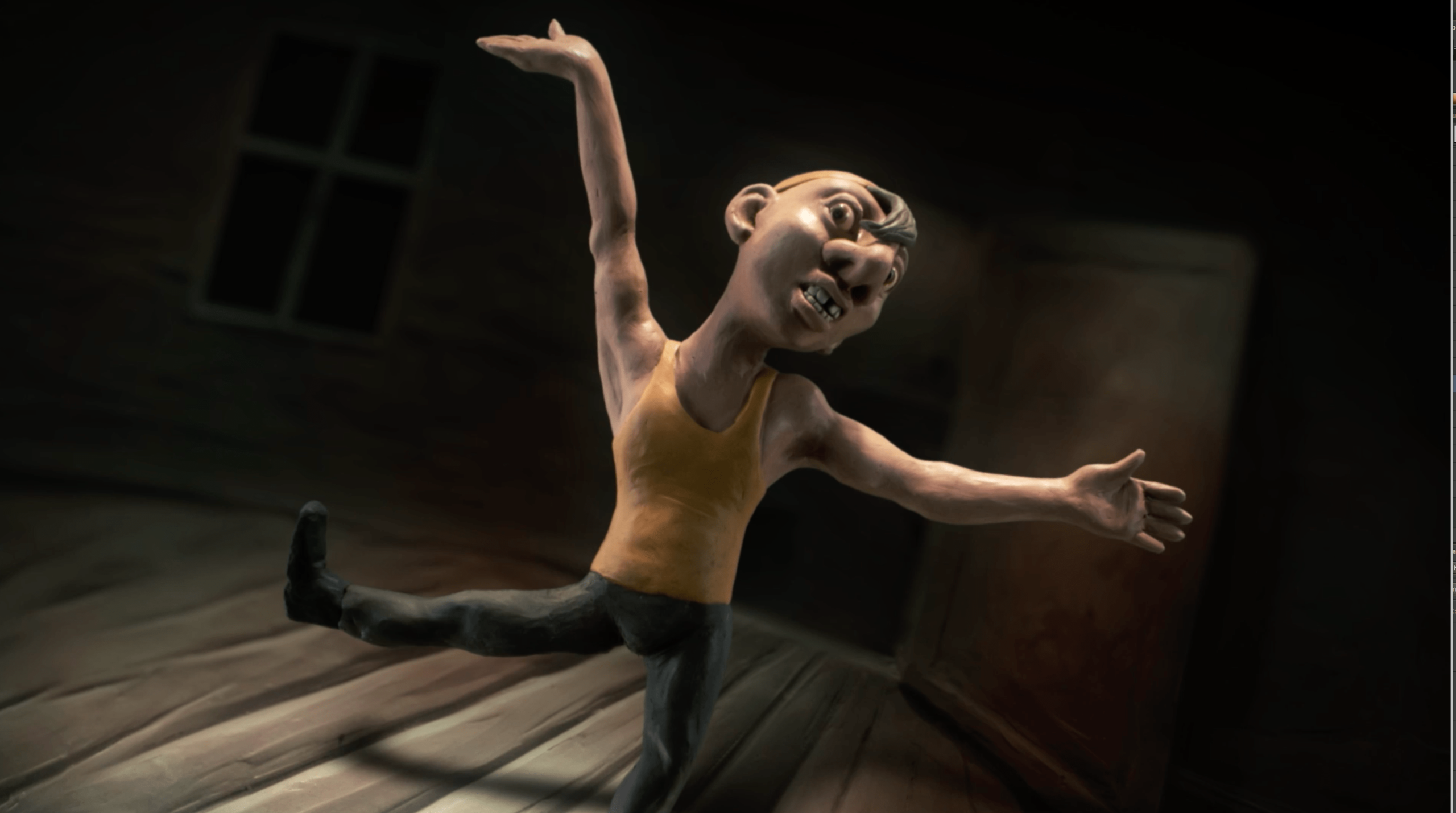
Creating the characters was a much easier process in comparison. Comfortable with her medium of choice after so many years, she naturally started playing with clay, organically bringing to life caricatural beings with ridiculously big heads or deformed body parts, matching the grotesque of the story.
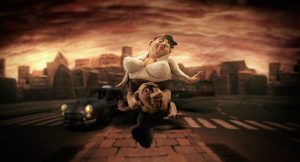
With its extreme plasticity and organic feel, what better than claymation to emphasize the surrealist situations Joko finds himself in, from carrying a well-endowed woman on his back all over town to literally merging with other characters into a human maelstrom of insanity. To accentuate the sense of absurdity in these unnatural situations, the director insisted on playing with perspective, especially for the running scenes and exaggerated body movements. To achieve this, the most complex scenes were meticulously storyboarded, each movement with ever-changing angles drawn in detail. Based on this, her small team of only 4 animators set out to create an astounding total of 500 puppets, some of them used for as little as one second on screen.
Hard to believe when you see the final result, that Izabela thought at first of using simple black sets as if in a theater to let the puppets and the animation shine. That was until Susanna Jerger, a modeler who created backgrounds for several Wes Anderson films, came on board. Joko’s town became a character of its own, entirely built in hand painted clay, from its busy streets to the minuscule lush red curtains of the hotel where Joko’s rich clients are staying. Down to the very sky minutely painted in orange hues channeling a dystopian sunset. But what really strikes you when watching the film is an explosive visual energy rarely seen in claymation. Izabela is all praise for her small team of talents gathered from Germany, Poland and the Czech Republic, who combined their skills to pull off this feat. For her who learnt animation 30 years ago equipped with multi-plane tables and 35mm cameras, it was new territory and fascinating to witness the possibilities of digital post-production. Countless photos of elements of the sets were taken, scanned and processed. Extra camera movements were added to boost the dynamism of Joko’s crazy rides. Blending analog claymation and digital after effects, the result does look incredible and genuinely still blows away the director herself.
That sense of wonder that seems to emanate from her at all times is taking Izabela on a myriad of new projects. As a teacher of animation, she is excited to spot new talents and to work with them. She is currently involved in a project by one of her students and will soon join her Joko team member Karolina Sendecka on her short film focusing on Picasso’s time spent in the 60s in communist Poland. She is also starting her own next project soon, an erotic film inspired by the work of South African artist William Kentridge. This will be her third film using charcoal and she is already looking forward to experimenting with new textures and possibilities. And just like that it seems she has already jumped into another world, smiling almost mischievously.
Penulis: Hélène Ouvrard








Discussion about this post