






Each year, Minikino Film Week (MFW) invites an artist to collaborate on creating a visual illustration concept. Over the past decade, MFW has worked with artists like Syafiudin Vifick, Jonathan Hagard, Monez Gusmang, Merio Felindra, Andy Praditya, and Edo Wulia.
This year, Dr. Bambang Tri Rahadian, M.Sn., a.k.a Beng Rahadian, is the artist contributing to the MFW11 visual design. Known as Mas Beng, he is an active illustrator and a fine arts lecturer, serving as the Head of the Visual Communication Design program at the Jakarta Institute of Arts.
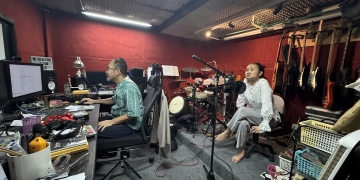
On March 14, 2025, Alda Hoya, MFW10’s Publicist, and Natania (Nia) Marcella from the Minikino Education team, spoke with Beng on a Zoom call. Beng shared his journey—from the initial invitation by the MFW committee through its director, Edo Wulia, to the inspirations and style behind his artwork.
Alda: How did your journey as this year’s MFW artist begin?
Beng: It actually started with a casual chat with Edo. We talked about me creating illustrations and visual assets for MFW. I was thrilled because MFW is an amazing event, and everyone involved is great. So I immediately agreed.
When it got closer to the time to create the illustrations, I drew a blank. “What kind of illustrations should I do?” I looked at past MFW illustrations—from Jonathan Hagard and Monez Gusmang—and I thought, “What’s something new that I can bring?” Finally, when I got an idea, I started to draw.
Edo and Cika (Fransiska Prihadi, MFW Program Director) gave me the space to explore anything. In 2024, I came to MFW10 to observe and enjoy the festival. From there, I was able to interpret what the events were like, and eventually, I made the illustration.
Alda: You mentioned earlier that you talked with Edo. What was the process like, from that conversation to finalizing the characters?
Beng: The conversation with Edo happened last year during MFW10. After watching a film at one of the cafe venues, Edo and I grabbed a bite and chatted. We weren’t talking about content or what the drawings should be, it was just a general conversation. It was only at the end of the year—around November or December 2024—that the idea came to focus on the audience.
I thought that from all the illustrations out there, I hadn’t found any that focused on the audience. To me, at any festival, the real stars are the audience members. Filmmakers already have their stage, as their work is being featured at the film festival. But what’s a stage without audience?
I interpreted these audience members as animals. These animals are not metaphors for humans, nor are they symbols. Consider Minikino an alternative world, and its audience is also alternative.
I saw potential. I created several characters to represent the audience. From their sitting positions to their fashion, the characters I created are very diverse, because that’s what I saw at MFW. When I look at festivals in Jakarta, the people who attend are almost all the same. Their way of self-expression is generally similar; their social class is probably the same. But at MFW, it’s truly diverse. They are so unique that I thought, “This would be fun to translate into visuals.”
Then, there was one common icon: the plastic warung bakso (meatball food stalls) chairs. When I attended MFW10 last year, I sat on one of those chairs. A foreigner was sitting there, other audience members too, everyone was sitting on those chairs and they were enjoying themselves. They didn’t have any issues with the seating.
So for the audience, they are more focused on what they’re watching. They can sit there, then move to another venue, and the situation might be different, more comfortable, and so on, but they still appreciate what they’re watching above anything else. I didn’t hear anyone complain about the chairs. Everyone was focused. The people who come to Minikino truly go there to watch short films. They’re not looking to show off. They don’t come for status or social standing. They come because they want to watch short films, and it turns out they’re from all different regions. I met people there, in Minikino, in Bali, whom I rarely meet elsewhere.
Maybe I’m one of those characters myself. One day I can become the Frog, another the Komodo Dragon, the Bird, the Monkey….

Nia: Was there anything new you explored in the process of creating these MFW11 characters?
Beng: I am used to drawing from established, pre-existing characters. In creating the MFW11 characters, I am creating my own characters. However, the influence from my past work is still there. The way I draw my lines, the anatomy… there’s definitely an influence from my past work.
What I explored here was the colors. The skin tones tend to be dark. I layered them with the texture of watercolor paper that already has color. This is visible when you zoom in. If you zoom in on the high-resolution version, you can see that the clothes, glasses, bags, and chairs are all flat. The skin layers, however, have added watercolor paper texture with color, which gives them depth.
Now, this is a bit difficult to reproduce, because the textures can’t be color-dropped or copied easily. All the colors are distinctive. But then again, it’s fine if they are produced with flat colors. As long as they are close enough, that’s okay.
Alda: When you were creating these 11 characters, did you ever think of naming them?
Beng: I didn’t think of it, but it would be cute if they had names.
(Minikino editor’s note as of August 17, 2025: For readers of this article who are active on Instagram, let’s find all eleven MFW11 characters on Instagram and follow them!)
As for the drawing style, I’ve been using it since I was a teenager. Back in high school—I attended the School of Fine Arts—there was a period in my final year when I was working while studying in Bandung. I worked at a studio called Anemik, Animation and Comics. At the time, the studio was working on a comic for Dufan (Dunia Fantasi; Fantasy World, a theme park) in Jakarta. Dufan had characters. There was a crocodile, a garuda, a tapir, a frog, and others. When I was drawing the characters for MFW, my memory went back to that time, to those drawings.
It was so much fun to create them. I drew those characters again, the ones I had learned from drawing the Dufan characters for the Dufan comic. This was repeated when I worked for an animation company in Kuala Lumpur, Malaysia. When I was there, I also worked on animal illustrations. I encountered crocodile characters and other animal characters again. So, the characters I created for Minikino are actually a collection of those memories. It was really enjoyable to make them.
Initially, I wasn’t sure if Edo would accept my drawings. I wasn’t confident when I sent them. I thought, “Is this okay? Does this look too childish? Is it too much pop?” If you look at MFW’s previous characters, they tended to be non-figurative. Even if they were figurative, they were symbols that made people think when they saw them. Then this year, I came in with a drawing that had a pop character. A drawing that looks like it belongs in a children’s world. But it turns out, Edo liked it. I’m grateful that he liked it.
Alda: Have you ever thought about the characters’ personalities?
Beng: Yes, I have thought about their personalities through their gestures. You can see their personalities from how they sit. Some are serious, some are moving, some have their feet up, some have their hands up… that reflects their personality. I appreciate it that it is getting noticed. I really wasn’t confident when I sent it. I even asked my wife, “Is this okay? Is it too pop?”
Nia: Do you have a favorite character?
Beng: I was most serious when drawing the Komodo Dragon, that lady. I was originally going to draw the komodo as a man, but it ended up being a woman. I never conceptualize beforehand when I draw. My process is never completely linear. I just draw and find the character.
The first character I made and thought of was the Komodo Dragon, because at the time of making it, Edo was recently in Labuan Bajo. I thought, “A Komodo might have followed him.” Hahaha. So that was the first one I drew. The others came after that. The second, third, and so on just came suddenly. However, I did try to create animals from the archipelago.
I also didn’t want to over-emphasize the Indonesian identity, because the illustrations represent the audience, and the MFW audience is global and international. So, I also created animals that are easily recognizable to people from other countries. So this isn’t about showcasing endemic animals, but just common animals. Because when I was an audience member, I was just a regular audience member, too.

Alda: Are there any other characters inspired by people close to you?
Beng: No, I just remembered what the audience members I met at MFW were like. For instance, some were wearing shorts, some were tall, some had a punk street style of clothing. So, that’s it; I just looked at what I remembered. When I thought about it, my mind immediately recalled those things because they were the most recent. That means they were stored in my long-term memory. If I see something and then forget it, it means it didn’t make an impression. But when I remember, “Oh yeah, there was a short person, then there was this kind of punk person… and this one person wearing a leather jacket in Denpasar….” These things get stored in my memory. The rest I improvised and combined.
Alda: Out of the 11 characters, which one was the most difficult or challenging to work on?
Beng: I think it was the Bird. The Bird was a bit problematic to create. I was confused about how to depict its costume. Finally, I made it look like a representative of a soldier. That one was definitely the most complicated.
There’s also the Anoa. I had a hard time drawing its face, because it could look like any other animal. It could look like a dog… anything. But on that, I am not necessarily inviting people to immediately recognize what animals the characters are. The important thing is that I tried to draw what was in my head, and that’s how the Anoa’s depiction came to be, with its gestures and everything. The Anoa is the character wearing a black shirt, the one with a chain on its pants.
Alda: If you were asked to bring one character to MFW11 with you, which one would you choose?
Beng: Out of the 11 characters… who would it be? Hmm…. Maybe I’d bring the One-Horned Rhino with the plaid shirt. He seems enthusiastic about watching shorts. I want to be swept up in that atmosphere. Additionally, the Crocodile, who is also similar to that; he also looks tough, but he can be understanding and gentle when watching a film.
Alda: When all the characters were finished, how did you feel?
Beng: I showed the results to Edo. He said they were funny. I was happy. I wasn’t confident at first. Then Cika added that she liked the characters, too. For me, the important thing is that my work is accepted and appreciated. And I hope it’s accepted by everyone. My fear was that the characters would endanger Minikino’s image. I was worried.

Alda: During this whole process, were there any unique facts?
Beng: The use of the chairs, for example, they’re also used at a festival in Sri Lanka, if I’m not mistaken. They’ve become an icon. But just the chairs. Because they use those chairs throughout the festival. But here, I’ve also explained that the venues are different, and the seating is also different. I just happened to really enjoy watching shorts in that chair because I saw other audience members enjoying it, too. The other audience members were happy when they were watching. You know, with their feet up, holding a beer, just enjoying themselves with the person next to them… Some looked serious, some had their hands crossed…. The diversity of the audience is interesting.
Alda: So when you were watching, you were really paying attention to your surroundings….
Beng: Yes, first of all, it was my job to observe, but the content really stuck with me. That’s what I remember. So, there aren’t any specific unique facts, but focusing on the gestures, those are genuinely the gestures I saw. I saw that’s how people watched there, so comfortably.
Alda: And besides the process itself, what makes this work different from your other works?
Beng: I think these characters are all new for me to draw. I often draw Komodo Dragons, but this Komodo has different colors. That was for a project I did in Flores. So I often draw Komodos and Crocodiles, but the other characters are new, some I’ve never even created before. So they were truly created for this event, and I’m giving them to Minikino.
Alda: Three words for your artwork for MFW11.
Beng: First, honest. Because this is my honest portrayal of what I witnessed there. Second, enjoy. So I tried to depict that enjoyment in the characters’ gestures. Third, new. This is genuine. So, I won’t use this for any other projects outside of this one. It was genuinely made for this festival. So it’s not the same as any other characters. Maybe after this, I think, it might be a good idea for them to be in a comic, for example. Who knows, maybe I can talk to Edo about it later.

About Beng Rahadian
 |
Beng Rahadian lives in Jakarta and teaches illustration at the Jakarta Institute of Arts. Since 2004, he has been active in the comic industry and art community, publishing cartoon books and exhibiting his work in Germany, Belgium, and Poland. His comics have received awards for Best Comic and Best Story. Since 2017, he has also worked as a curator in Jakarta for the National Gallery, Bentara Budaya, and Salihara Arts Center. He is a co-founder of the Indonesian Illustrator Professional Association and Jakarta Food Sketchers. He published the comic book “Mencari Kopi Aceh” (Finding Aceh Coffee) in 2016 and an illustration book about Jakarta street food in 2023.
Find Mas Beng among the audience seats during MFW11, attend a discussion session with him, and check out the MFW11 Merch Shop for a copy of the book “Mencari Kopi Aceh.” |
Interviewers
 |
Alda Hoya
Bringing together her love for film and expertise in media publication, Alda creates strategies that bridge stories and audiences. With a foundation in International Relations and real-world experience, she ensures that short films gain the visibility and impact they deserve. |
 |
Natania Marcella
Nia is an Education Staff at Minikino. She focuses on honing her film criticism skills and contributing in short film education at Minikino, driven by her belief in the transformative potential of diversity and community in nurturing a vibrant film culture. |





Discussion about this post