

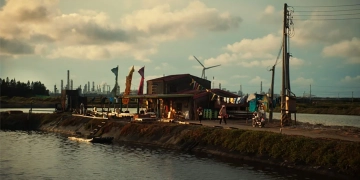


How does it feel to be burned out? And how to find a way out of this state? These questions represent the premise of Thelma Santoso’s short film Burnout. In a five-minute-long animation Burnout visually depicts how it feels like to lose yourself in work until drowning in the dark.
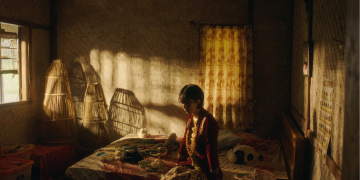
Raina is an artist that uses social media as a platform to gain awareness of her work. One night, one of her posts gets viral. From then on, she can hardly save herself from job requests anymore. Gripped by enthusiasm and joy about her success, Raina drowns herself into work. In doing so, she forgets to take care of herself. Living in full isolation with no sleep or proper food, the pressure to finish the pile of work takes over. When she accidentally spills coffee over her laptop, her entire work gets lost. Breaking down on her bed, she drowns in a state of helplessness and anxiety.
Burnout is part of a student project and represents Thelma’s first full-length film. For her previous works, the young artist, who studies Animation at the Bina Nusantara University mainly produced short clip animations. In the search for new challenges, Burnout shows her aspiration to grow as an artist. For that, she aspired to choose a topic that hits “close to home” and especially concerns her own generation working and the work in the art industry. As she experienced in her environment, young artists are often affected by the pressure to succeed. The use of social media channels, which has become unavoidable for many artists to present their work, can enhance this pressure. Alluding to mental stress, Thelma explained that “there is the pressure to keep on producing content. At that moment, it will make us happy, wanting to post again and again in order to receive more likes. But we also forget to take care of ourselves, only staying at home and prioritizing our work”.
Burnout as a mental health issue is a close problem in Thelma’s life. But on the other hand, it is still rarely discussed openly because it is shrouded in taboo. This taboo on mental issues persists among the older generation. As she explains, “When I talk to friends or close people, we can relate as artists, but if we talk to our parents or teachers, they don’t seem to understand us enough, thinking that we are just lazy, or don’t have the drive to improve.” Thelma assumes that this taboo is caused by the rarity of films and media in Indonesia talking about this topic. Her film Burnout, therefore, aims to break this tendency. Animation film was especially suitable for her idea, as it enabled her to metaphorically visualize the inner life of the protagonist in her pain.
What makes Burnout remarkable, is the subjective perspective it takes in representing it. Before starting the production of her film, Thelma’s research focused on grasping how it feels like to be burned out, relating to personal experiences of people that have already suffered from it. During this process, one quote especially got stuck in her mind: “It feels like dragged down or stuck in the mud”. This also resonates with the narrative of her film, which begins with a hopefully-happy atmosphere, but slowly submerges into a state of devouring darkness.
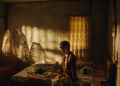
This contrast also sets the aesthetic choices in Burnout. Taking her inspiration from films such as the Mitchells vs. the Machines and Spider-Man: Into the Spider-verse, Thelma combines 3D animation with hand-drawn comic-style techniques in 2D. In doing so, she visually juxtaposes the switching mental state of the protagonist. Following a snappy style that aims to reflect today’s tendencies in 3D- animation at the beginning and end of the film, these parts depict the setting of Rain’s boarding house through natural and bright-colored choices.
As opposed to, when Raina loses all her work and breaks down on her bed, all colors around her disperse into a 2D-sketched aesthetic in black and white. The loss of color and the more sketchy and chaotic style of this part display the state of burnout that the protagonist is sinking into. Sitting in front of her laptop, Raina’s depiction becomes dark and blurry. Even more, Raina’s face seems to melt away, as if droplets of wax are rolling down her skin, personifying how it feels to literally “burn out” like a candle. Spiraling around in a room without gaining hold and leaving black traces behind her, she is stuck in a state of anxiety.
At the end of the film, Raina wakes up on her bed again. And when her friend enters the room and gives her a hug, the colors are slowly returning into Raina’s life. With the quote “You will burn and you will burn out; You will be healed and come back again”, the film ends on a hopeful note. Of course, you can’t make the state of Burnout disappear with one animation film. But what Thelma aims to express with her work is that it is okay to show yourself vulnerable in the hope that her film can offer some comfort.
Burnout is a short film with a clear message: It seeks to teach empathy for people suffering from the state of emotional and mental exhaustion and draws awareness on a topic that is still affected by taboo. With her film, Thelma inspires open discussion on mental diseases. But it also raises concerns such as how to prevent Burnout in a society in which it becomes more difficult to separate work from private life? Or what is the role of social media in this process? As for her future projects, Thelma would like to follow these issues, exploring the protagonist of Burnout through different art forms. So hopefully, we will see Raina soon again!




Discussion about this post